The refugee condition of Vietnamese boat people
The SympathizerThe refugee condition of Vietnamese boat people in The Sympathizer is more than displacement from one country to another: it is a struggle over where people may live, what they may remember, and who has the power to represent them. Resettlement brings sponsors, jobs, welfare, and scattered communities, but not security or a reliable return to the life left behind. In the novel’s final movement, the unnamed narrator and Bon prepare to flee Vietnam by sea, joining people escaping a revolution that has made even former revolutionaries feel they have no place in their own society.
Dispersal and Resettlement
The refugees’ first life in the United States depends on sponsorship. After reaching San Diego, the unnamed narrator asks Avery Wright Hammer for help leaving the camp. Professor Hammer finds him a clerical job in the Department of Oriental Studies, raises money among former teachers, and helps him reach Los Angeles. The narrator uses the remaining funds for a bus ticket, motel nights, an apartment deposit near Chinatown, and a used car. He then seeks a sponsor for Bon through local churches. The Everlasting Church of Prophets agrees to sponsor Bon and employ him nominally, allowing the two former comrades to reunite in September in an apartment they describe as genteel poverty. Resettlement is thus made possible by individual acts of aid, but access to that aid is uneven and consequential.
The General and Madame also reach Los Angeles through sponsorship, but their new circumstances expose the distance between former status and refugee life. The General is unemployed, no longer commands an army, and sinks into anger and melancholy. The crapulent major, once an intelligence specialist in Saigon, becomes a gas-station attendant in Monterey Park, paid in cash while his wife sews in a sweatshop. Their stories show how military rank and professional skill fail to guarantee a stable place in the receiving society. Bon, formerly capable of parachuting, long marches, and expert shooting, can find only part-time work as a church janitor. He receives welfare as well, regarding it as a more fitting return for service in a war determined by the United States than a medal would have been.
Resettlement also breaks up families and disperses the refugee population across the country. The unnamed narrator’s account to his aunt describes people seeking sponsors from former employers, military advisers, lovers, churches, and even casual acquaintances. Some leave as families; others are divided among destinations. Many are sent far from the warm western climates they associate with home, to states whose names they struggle to pronounce. Before leaving camp, refugees exchange addresses and phone numbers, beginning an informal network for finding jobs, comparing taxes and welfare, and locating places with less racism or more people who look and eat like them. The network answers some needs created by dispersal, but it cannot undo the scattering that produced them.
Community, Memory, and Everyday Survival
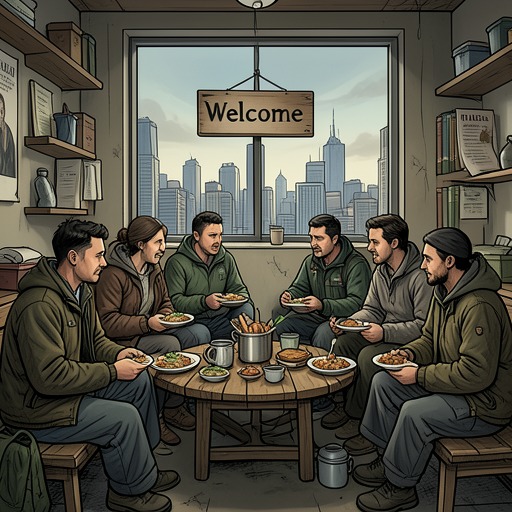
The refugees imagine what they might have built if allowed to remain together: a self-sufficient community with workers across professions, religions, political positions, and social classes, and enough people to elect a representative to Congress. Instead, bureaucratic resettlement distributes them across the United States. They gather in basements, churches, backyards, and beaches, bringing their own food rather than paying for concessions. These small gatherings preserve social ties, but their makeshift character also registers the loss of a common home and the difficulty of recreating one in a country where the community has been scattered.
Food becomes a measure of that loss. Dependent on Chinese markets, refugees try to reproduce familiar meals but find that the food carries an unwelcome Chinese tinge and lacks the variety and complexity they remember. Fish sauce, especially, stands for what cannot be replaced: the narrator recalls its distinctive taste and its role in defining a Vietnamese culinary world that foreigners misunderstand. Refugees trade stories over dried squid, crowded around kitchen tables and close together on sofas and carpets. Their shared memories keep the past present, but the food that evokes it also reminds them that a remembered home cannot simply be recovered in exile.
The novel sets these collective rituals beside individual hardship. Bon remains listless with grief, drinks heavily, and works nights cleaning the Reverend Ramon’s church. Welfare and cash wages keep him afloat, but do not restore the role or purpose he had as a soldier. The crapulent major’s family likewise adapts through low-paid work and public assistance. His American-born twins receive the names Spinach and Broccoli after he panics when a nurse asks for American names; he hopes the names will help them be strong in a country he considers unforgiving to the weak. Such practical accommodations do not amount to uncomplicated assimilation. They reveal the daily improvisations through which refugees try to secure a future for their families.
The Time and Politics of Exile
A hardwood clock shaped like Vietnam gives physical form to the refugees’ relation to home. Its hands pivot in the south and its numbers surround Saigon, making the lost country both a map and a timepiece. The unnamed narrator reflects that distance from home is finite, while the years required to return may be infinite. The clock expresses a life organized around waiting: for a return, for a change in political circumstances, or for news that the lost country can again be inhabited. Exile is measured not only in miles but in suspended time.
That suspension coexists with political connection across borders. In Los Angeles, the unnamed narrator receives messages from Man through his aunt’s letters. Invisible writing made from rice starch conveys information about conditions in Vietnam and the reception of the narrator’s reports. The messages maintain a secret link to the country he has left, even as life among the exiles appears to consist largely of complaints and grief. The contrast between that hidden communication and the public dispersal of refugees shows that exile does not sever political ties; it changes their form, making connection clandestine and dependent on interpretation.
The possibility of return is further complicated by the flag and clock displayed in the General’s home. The flag represents the defeated Republic of Vietnam and, in the General’s account, the free Vietnamese people. The clock, meanwhile, turns the homeland into an object carried into exile. Together they preserve competing claims about what Vietnam means: a lost country, a political cause, and a place whose people remain divided over freedom and liberation. Neither symbol provides a practical way home.
Flight by Sea and the Claim to Survival
When the unnamed narrator returns to Vietnam, he discovers that victory has not secured him a place in the new revolutionary society. After completing reeducation, he concludes that former graduates of the camps, even those who consider themselves revolutionaries, have no place there and cannot be represented. The country is also at war again: Vietnam has invaded Cambodia after Khmer Rouge attacks, and China has raided Vietnam’s northern border. At the navigator’s home in Saigon, the narrator and Bon learn that yellow music is banned and only revolutionary music is allowed. The ban makes cultural control audible through absence: familiar songs no longer play in cafés or on transistor radios.
The navigator, Bon’s cousin, plans an escape with his extended family. He has already been caught twice trying to leave by boat and fears a third capture will send him to a northern reeducation camp from which no one has returned. This time he intends to take his wife, children, their families, and several in-laws. He estimates the chance of survival at fifty-fifty, based on hearing from only half of those who fled. Bon accepts those odds. The refugees’ decision is not presented as confidence that escape will succeed; it is a judgment that the danger of remaining is greater than the danger of the crossing.
The departure plan depends on secrecy and cooperation. Families will leave Saigon as if taking a short trip, travel by bus to a village three hours south, and use a coded exchange with a ferryman before boarding a skiff. They will join the navigator’s wider clan and transfer to a fishing trawler built for 150 people, most of whom will be concealed in a hold intended for far fewer. The navigator warns that the hold will be hot, foul-smelling, and difficult to breathe in. The unnamed narrator and Bon pay their fares with the commissar’s gold, concealed in a false bottom of the narrator’s rucksack. They carry both a cipher and their manuscript, wrapped in waterproof plastic: the words they have written are part of what they mean to preserve through the flight.
The final image does not promise a safe arrival. Those preparing to leave include infants, children, adults, and parents, but no elderly people willing to risk the voyage. They include people of varied skin tones and accents, many Chinese refugees persecuted for being Chinese, and others shaped by reeducation. The narrator resists the condescension he hears in the collective label boat people: those fleeing are not primitives or objects of pity, but people attempting to remain alive and to represent themselves. The departure makes their condition starkly visible—exposure to political repression at home and mortal danger at sea—while their closing promise, “We will live!”, insists that survival remains an act of will even when no safe refuge is assured.